Why does Edinburgh have vaults?
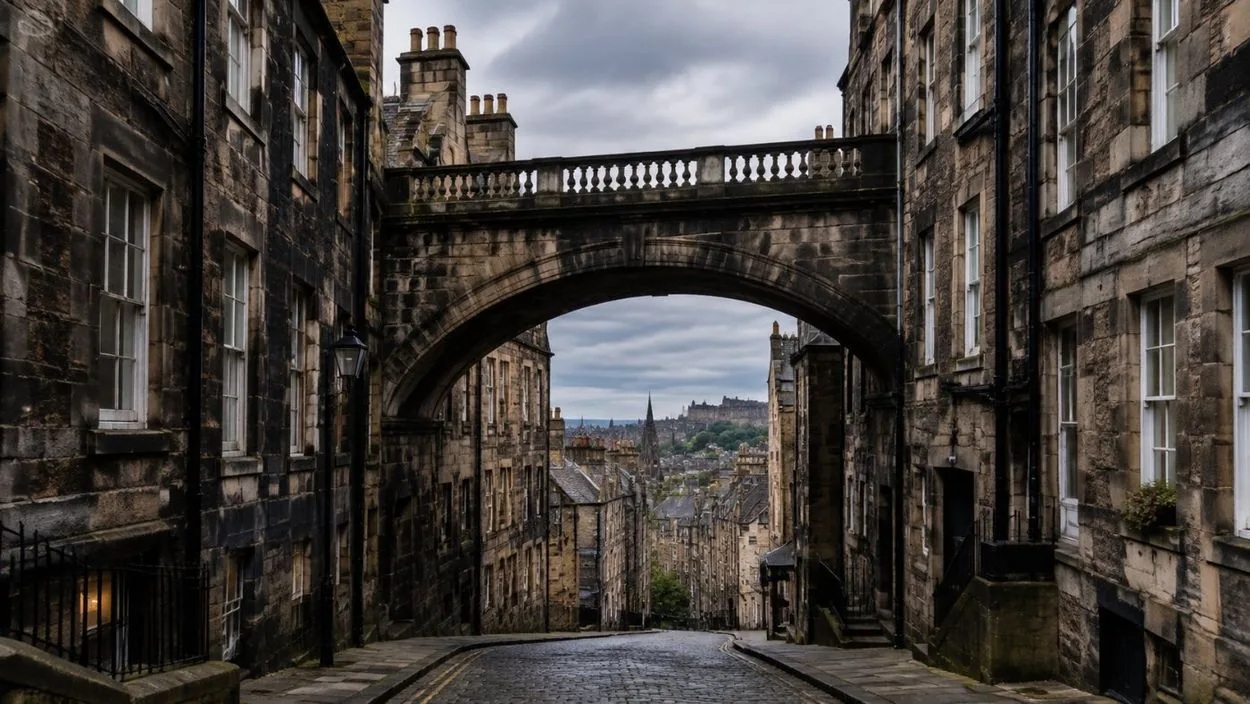
A bridge nobody can see
Walk the South Bridge today and you will not know you are on one. Tenements were built along 18 of the 19 arches almost immediately, so the structure is hidden inside a street of shops and flats, and only the arch crossing the Cowgate is still open to the sky. That single arch is the best free view of the whole business, and it explains the rest of the page: if the bridge is invisible, the rooms inside it are twice as invisible.
The chambers vary enormously. Some are about 2 square metres, barely a cupboard; the largest run to around 40. That range is why one guide can tell you a vault is a cell and another can run a music venue in one, and both be telling the truth.
What they were built for
Trade. From 1788 the rooms held stock and workshops for the businesses overhead: taverns, cobblers, cutlers, smelters, victuallers, milliners. A cutler wants a dry store under his shop and a tavern wants somewhere cool for the barrels, and the arches offered both at the cost of walking down a stair. For about seven years, that worked.
Why they failed
Money ran out during construction and the bridge was never waterproofed. Rain came through the roadway and into the chambers, and it never stopped. Abandonment began as early as 1795, and by the 1820s the trades had gone entirely, driven out by damp stock and bad air. No ventilation, no drainage, no daylight: a merchant with a choice does not keep leather down there.
Who lived in them afterwards
The poorest people in the Old Town, once the businesses had given up on the space. Among them were Irish and Highland incomers arriving into a city with nowhere to put them. Conditions were about as bad as the phrase allows: no sunlight, no running water, no sanitation, poor air circulation, fish-oil lamps for light. Archaeological evidence suggests habitation carried on until roughly 1860.
I grew up two closes uphill from those doors and spent three student years pulling pints in a Cowgate bar built into one of the arches. I mopped a floor that was somebody’s cellar in 1799 and, later, somebody’s home. That is the fact the tours are for.
1985, and the rubble
The chambers came to public attention in 1985, and Norrie Rowan is credited with finding them. He and his son excavated through the 1990s, taking out hundreds of tonnes of rubble by hand and by barrow to get rooms back to floor level. What came out with it was the ordinary rubbish of poor lives: thousands of oyster shells, which were the cheap food of the period rather than a luxury, clay pipes, buttons, broken medicine bottles and children’s toys.
What the excavation turned up
- Oyster shells in the thousands
- Clay pipes
- Buttons
- Broken medicine bottles
- Children’s toys
What did not survive
- Any surviving furniture or fittings
- Written records of who lived down there
- Lighting, drainage or ventilation of any kind
- A single original door still in use
Ask your guide which side of the bridge you are under. The north-side chambers are the ones used for tours; the south side runs as event and music venues, and through August the underground carries dozens of Fringe shows a day. Same arches, entirely different evening.
Where the two vault systems fit
Both the South Bridge chambers and the Blair Street chambers sit under this same complex, but they are separate rooms held by different operators and entered from different streets. Neither is Mary King’s Close, which is a buried street rather than a bridge vault. Getting those three straight is most of what this site is for.
See it with someone who knows the rooms
The one-hour South Bridge tour is the shortest way to stand in one. For the version with artefacts you can hold, read which tour is best.
Frequently asked questions
How many Edinburgh vaults are there?
Roughly 120 chambers, built into and beneath the 19 arches of the South Bridge, ranging from about 2 to 40 square metres. Only a handful are on any one tour route.
Why were the Edinburgh Vaults abandoned?
The bridge was never waterproofed, so the chambers leaked from the start. Abandonment began around 1795 and the trades had gone by the 1820s; the poorest of the Old Town then lived there until about 1860.
When were the Edinburgh Vaults rediscovered?
They came to public attention in 1985, and excavation through the 1990s removed hundreds of tonnes of rubble. What is left to see is bare, which is why the guide matters.